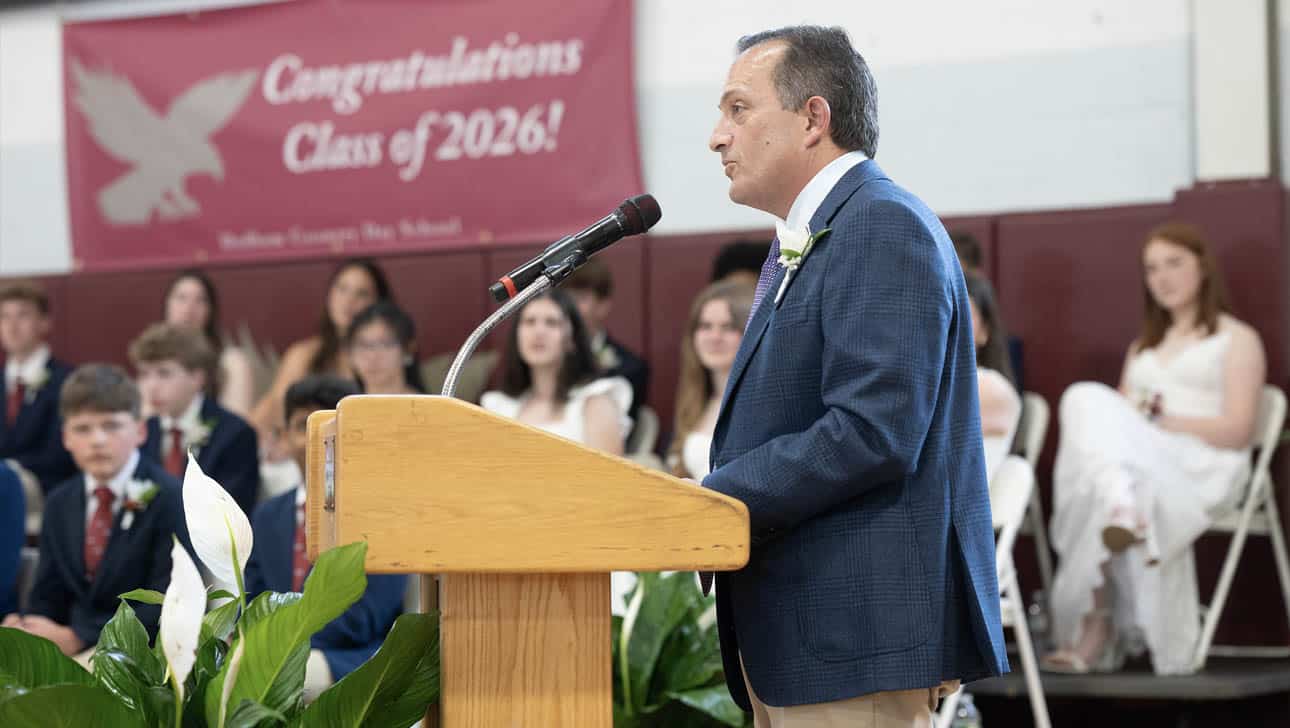
Good morning, members of the Class of 2026. I’m excited to be the sixth or seventh person to congratulate you on this very special day.
It is truly an honor to speak with you today, and it means so much that you chose me for this role. I have loved getting to know each and every one of you, loved the connections we’ve built together, and I am incredibly proud of the young adults you are becoming.
This moment is especially meaningful because like you—as you know—I am also moving on from DCD. I’ll be starting the next chapter of my career while you begin the next chapter of your education. We are, in a sense, all graduating together—and that’s kind of cool.
We also now have our handprints together on the DCD hallway, giving us a permanent connection to each other and the school! And that is also kind of cool.
Graduation gives us the opportunity to reflect on what DCD has meant to us and what we will carry with us from our time here.
Without hesitation, I can say that my relationships with you, and the other students I have taught (sorry, there were some others!) have been the most meaningful part of my DCD experience. Walking into the classroom each day opens an almost endless world of possibilities. Exploring that world together continuously reinforces my faith in you, our students, and in DCD’s learning model. It has also inspired me to become a better teacher and, ultimately, to pursue becoming a head of school.
So thank you for all that.
It has also given me the opportunity to share with you one of my greatest passions: understanding history and how it shapes the world we live in.
More on that in a moment.
As I think about what you’re taking from DCD, I have both a belief and a hope.
My belief is that you are leaving our school with the academic, social, and emotional tools to succeed in secondary school and beyond. Whether you realize it or not, your entire DCD experience has been preparing you for this moment. Every teacher, coach, advisor, and staff member has worked to make sure you are able to navigate the challenges and opportunities ahead.
It may not always have seemed that planful to you, but trust me—there has been a method to the madness.
My hope is that you will use these skills and tools not just to thrive in your next school, but to make the world a better place wherever and whenever you can.
In Facing History, we talked about the idea of a “universe of obligation.” I encourage you to think broadly about the people and communities to whom you feel a responsibility and to look for opportunities to make a positive difference in their lives.
While this is not an easy task, you’ve already been practicing it through service learning projects, outside volunteering, and even by being big buddies to the Kindergarteners. You have started building the foundation for a life of impact by making a difference to those around you.
And as you continue on this journey, I believe there is one particular tool at your disposal that is especially important: that is the power of history to help you make a difference.
As you’ve heard me quote in FHAO many times this spring: “people make choices … and choices make history.”
See? I told you we’d come back to the history theme.
So to help you make choices that harness the power of history, I have three requests as you head off to the world beyond DCD–kind of your last assignment:
My first request is that you consciously make history part of your life.
No matter what path you follow in your school or career, take history classes. Read historical novels. Watch documentaries and movies that bring the past to life. Dig into the background of subjects that interest you. By doing these things, you will arm yourself with insights into the world that will help you better understand—and ultimately shape—the events around you. Nearly everything happening today has roots in the past that can help shed light on it. Know that history, and you’ve got a leg up.
My second request is that you take the time to understand the history of our country.
Doing so will make you better citizens. The ideals we’ve studied—individual liberty, equal protection under the law, checks and balances, and democratic participation—provide a framework for understanding both our nation’s successes and its shortcomings. Knowing those ideals will help you recognize when we are living up to them, when we are falling short, and how you can help move us closer to achieving them.
My final request is that you continue to be critical consumers of information.
This is one of the most important skills you have begun developing at DCD. We live in a world overflowing with information, opinions, and misinformation. Learning how to evaluate sources, identify bias, and think critically will help you make wise decisions and develop your own informed conclusions about what to do next.
I’m not asking you to do these things just because I’ve been your History—and Facing History—teacher.
They will actually help you in the real world.
Let me give you an example from my own life.
Recently, I shared with you the story of my work in Bosnia after the war there in the 1990s. We talked about the parallels between the Bosnian War and the Holocaust, particularly the questions of accountability and justice.
What we didn’t spend much time discussing was why I went there in the first place.
I came to believe that the people of Bosnia fell within my universe of obligation because I felt their civil and human rights had been violated. As an attorney, I believed I had skills that could help.
But I only reached that conclusion after immersing myself in the history of the region, and concluding that I didn’t agree with the public narrative of the war.
At the time, many news sources and public officials described the war as the result of ancient ethnic tensions that had simply spilled into the modern era. The more I studied the history, however, the more I came to a different conclusion: that the war was not inevitable, but was a deliberate effort by one group to seek political and military dominance over the others. Understanding that history changed how I saw the situation—and ultimately led me to act.
The point is that history didn’t just help me understand the world. It helped me decide what kind of role I wanted to play in it.
Remember that you can make the same type of choices. With your DCD education as a foundation, and with the power of history at your disposal, your ability to make the world a better place is essentially limitless–and I encourage you to push those limits to their fullest.
Congratulations again. I can’t wait to follow your paths into the future, and I will always have a special place in my heart—and on the wall—for the Class of 2026.